

Exploring Psychedelics and Mental Wellness with Matt Zemon
 Apple Podcasts Apple Podcasts
 Spotify Spotify
 YouTube YouTube
 Amazon Music Amazon Music
 Overcast Overcast
 Audible Audible
 iHeartRadio iHeartRadio
 Pandora Pandora
 Podcast Addict Podcast Addict
 Castro Castro
 RSS Feed RSS Feed
 Gaana Gaana
 Castbox Castbox
 Deezer Deezer
 JioSaavn JioSaavn
 TuneIn TuneIn
 Podchaser Podchaser
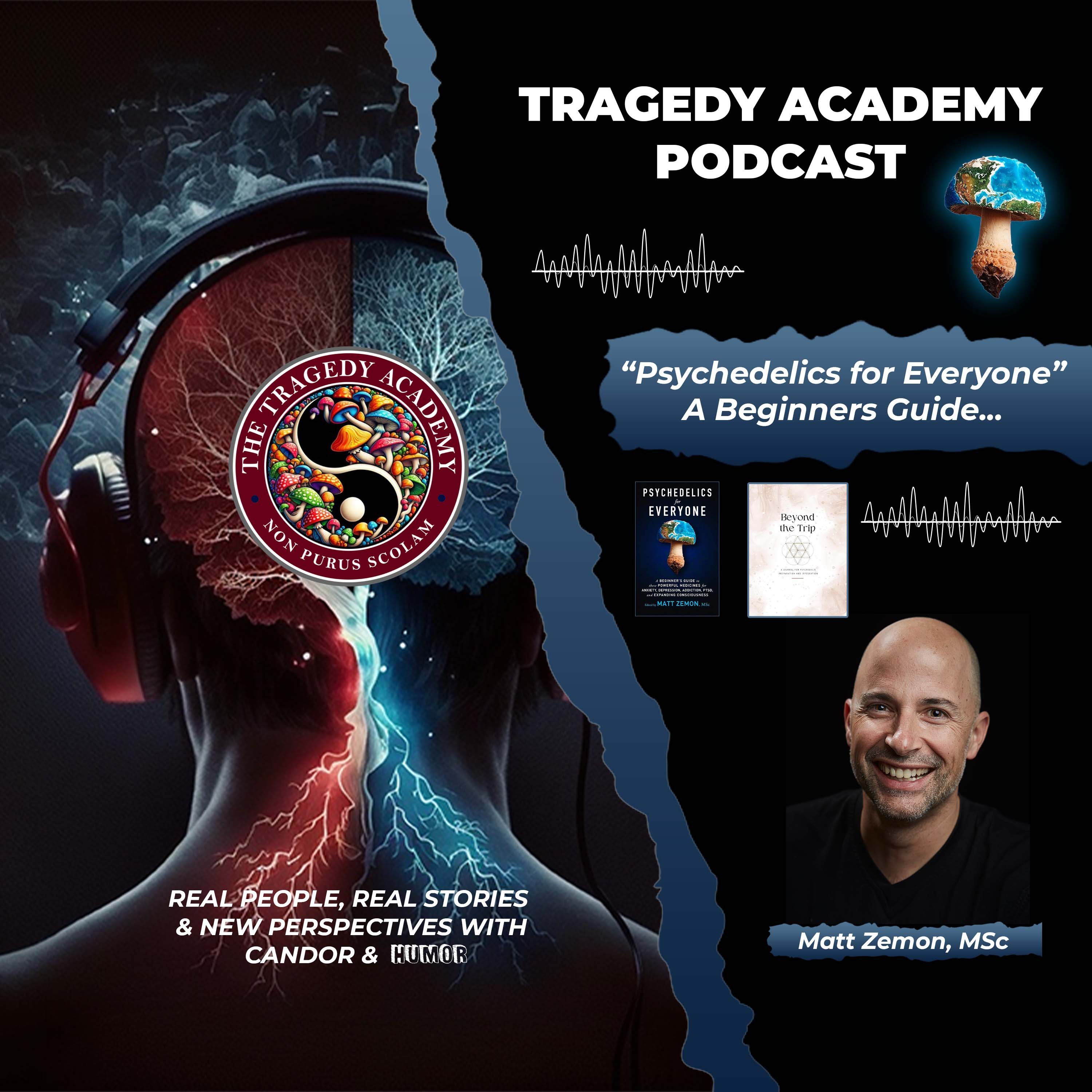
In this episode of The Tragedy Academy Podcast, Jay and Gary are joined by Matt Zemon, an explorer of consciousness and a proponent of psychedelic-assisted therapy. They delve into the transformative power of psychedelics in mental health and personal growth 🎙️.
Engaging and enticing verbiage: Join us in a captivating conversation with Matt Zemon, author of "Psychedelics for Everyone" and a master in psychology and neuroscience. Matt shares his personal journey of reconnection and discovery through psychedelics, leading him from a life-changing psilocybin experience to pursuing a deeper understanding of the mind. This episode promises to be an eye-opener as Matt, Jay, and Gary explore the intersection of spirituality, science, and psychedelics. Discover how these powerful substances can be profound healing, growth, and self-awareness tools. 🌿🧠💭
Key Takeaways:
🍄 [08:13] Matt's transformative experience with psychedelics led to a pursuit of understanding their impact on the mind.
🧬 [16:30] The importance of a holistic approach in psychedelic therapy, combining medical and spiritual practices.
💡 [24:01] Discussion on the potential of psychedelics to shift perspectives and aid in personal growth and mental wellness.
🌀 [36:28] Exploring mental health's cultural and societal implications and the stigma around various mental conditions.
🌎 [45:06] The role of psychedelics in societal transformation and individual empowerment.
Guest Bio: Matt Zemon, a dynamic voice in the field of psychedelic research and mental wellness, brings a unique blend of personal experience and academic expertise. With his Master's in Psychology and Neuroscience and his deep explorations into various psychedelic practices, Matt offers invaluable insights into the healing potential of these substances.
Guest Quotes:
🌟 [08:13] "I came out of that ceremony and thought, what the hell was that? It was incredible."
🔄 [24:24] "Psychedelics are not a cure. They're catalysts."
🤝 [41:07] "Our role is to create a safe container for people to do their work."
CTA for Show: Don't forget to subscribe to The Tragedy Academy Podcast for more enlightening discussions. Share this episode with friends and help spread awareness about the transformative power of psychedelics. "Be cool and keep learning." 🎧🚀
CTA for Guest: Explore more of Matt Zemon's work and insights. Check out his book "Psychedelics for Everyone," visit his website, and follow his ongoing contributions to the field of psychedelic research. 📚🔍
Matt Zemon (@matt.zemon) • Instagram photos and videos
Matt Zemon, MSc - Executive Director - Sacred Path Community | LinkedIn
Matt Zemon: books, biography, latest update
Psychedelics-Everyone-Beginners-Depression-Consciousness
Beyond-Trip-Psychedelic-Preparation-Integration
Thank you for tuning in to another thought-provoking episode of The Tragedy Academy Podcast. Join us next week as we continue to explore the depths of the human experience. "Be cool and keep learning." 🌌🎓
📲 Connect with us!
https://www.thetragedyacademy.com
✨ Resources & Affiliate Links:
💻 Create your own stunning podcast website with PodPage: https://bit.ly/3LSCBh5
🎙️ Elevate your recording game with Riverside.FM: https://bit.ly/3ImjNWD
👕 Love Jay's t-shirt from this episode? Get your own at INTO THE AM: https://bit.ly/431MLD5
📚 For Tragedy Academy-recommended books and authors, visit our Bookshop:
Youtube:
📺 Don't forget to Subscribe to our YouTube channel! 💥 https://www.youtube.com/channel/UCEUXqlregig6vcrvuVNGlKg
📲 Connect with us on socials!
Instagram: The Tragedy Academy Podcast (@thetragedyacademypodcast) • Instagram photos and videos
Facebook: The Tragedy Academy Podcast
Twitter: The Tragedy Academy Podcast (@Tragedy_Academy) / X
TikTok: The Tragedy Academy (@thetragedyacademy) | TikTok

The Tragedy Academy is a show created to bridge societal divides in a judgment-free zone using candor and humor.
Be cool. Keep Learning.
00:43 - Introduction and Setting the Tone
03:47 - Matt’s Work in Bridging Spirituality and Medicine
09:21 - The Power Within Us
10:17 - Numbing symptoms vs addressing root causes of illness
13:02 - Medications as a pause button, lack of holistic approach
15:55 - Lack of education and marketing in the medical field
19:49 - Three Approaches to Psychedelics in America
23:01 - Expressing gratitude for something.
23:35 - Repeating gratitude.
24:02 - Exploring Plant-Based Medicine for Mental Health
28:01 - Tools for Getting Back to Reality and Remembering Our Power
31:19 - Rethinking the Definition of Success in Society
34:09 - Profound Changes through Meditation
41:49 - Slip-ups and Consequences in Cancel Culture
44:35 - The Technological Divide between Generations
45:59 - The Best Time to Be Alive in History
53:43 - The Healing Power of Weed and Psychedelics
0:00 Music.
0:42 Welcome to the Tragedy Academy, a show created to bridge societal divides in a judgment-free zone using candor and humor. My name is Jay, and we are joined today by Matt Zaman. How are you doing today, Matt? Jay, I'm doing well. How are you doing? Living the dream. Matt is the author of an Amazon bestseller, Psychedelics for Everyone, a beginner's guide to these powerful medicines for anxiety, depression, and more. Can't tell you how excited I am about this. I think I could actually go through here and tell you that I have all these ICD-10 codes in your title. And I'm sure the more I probably check a lot of those. And Gary can probably confirm with me that he has a few of these as well that we live through.
1:24 How are you doing today, Gary? Doing good. Happy to have you on. This is definitely something me and Jay talk about a lot. And it's good to have an expert. We have our series, but we haven't really studied it much at all. So looking forward to everything you have to say. Looking forward to this conversation. It seems like you've been through a bunch of transformation and growth and you have me curious and yeah, looking forward to this. I love that you're curious because that means that you're passionate about what you do and how it impacts humanity. A lot of people want to just tell you about what they've gone through, not, you know, listen to others and take their experience as an additional lens that they could use themselves. That's right. So thank you for that. Yeah, that's this is all about learning, healing and growing in all directions. Oh, absolutely.
2:08 So why don't you tell us a little bit about yourself, how you, you know, stumble upon this journey and go from there? I am probably the last person who would think I'd be here today having this discussion. I had some friends invite me to a guided magic mushroom or psychedelic psilocybin experience. And that was so far out of my comfort zone. But they were trusted friends and they told me I was going to learn more about myself. And I like to travel and this is a chance to travel deep within. I was like, okay, that sounds pretty cool. But I went in with low expectations. And in that first journey, I reconnected with my mom who died when I was 22. She was 49. I felt incredibly safe and loved.
2:51 And then in the next instant, realized that I don't feel safe and loved in my everyday life. And I saw kind of story after story that I'd been telling myself that just wasn't true, kind of unravel. Came out of that ceremony and thought, what the hell was that? It was incredible. Ended up going back to school like as soon as possible to get a master's in psychology and neuroscience science to understand the science of it. But then I also was traveling around the country and the world, experiencing psychedelics delivered by different types of practitioners. So MDs, PhDs, Taita, shaman, and just did a deep dive into exploring consciousness.
3:32 And today I straddle the spirit where I do most of my work is in the spiritual world, working with spiritual leaders and people who are inviting people into kind of the sacred process of psychedelics. But then I also work with medical professionals and how they can incorporate spiritual best practices into their. Into their delivery mechanisms and protocols. So I help the spiritual people develop medical best practices and vice versa. And I just am thoroughly loving this continued exploration and realizing that this isn't a one and done thing. It's a lifelong practice. That's beautiful. And I'd like to take a moment and pause on the fact that you are working in both fields where you're paying attention to the spirituality behind it or the religious influences or the reality-based understandings that come from the use of these plant-based medicines.
4:31 But at the same time, understanding that science is not wrong and neither is spirituality. They just read two different ways about the same thing. They're describing what one person feels feels one way, but looks like this on a graph, right? So I commend you for immersing yourself in both sides of it, because I feel like a lot of people, when they find that spiritual journey, they tend to leave behind the logical people that are in their lives. And start dancing around in Birkenstocks, right? And everybody doesn't understand it. But if they turned around and paid it backwards, not paid it forward, or tip backwards and tell them, hey, look, what you believe is this is actually what they're talking about over here and vice versa.
5:23 Give it a moment. Maybe this type of plant medicine mimics this. That's one of the things that I want to get into later is how plant medicine can be a faster gateway or a different gateway into what is obtained through long-term meditation meditation, or internal reflection, or prayer, or whatever label you want to put on it. But to me personally, I feel like they're just a mirror. And the in-between is knowing that you're there. Let's stick with this for just a moment, though. This is a really beautiful concept that you just brought up. And in the old days, we just had healers. And the healers were both spiritual healers and medical healers. And as we have progressed in Western society, and progress is even probably the wrong word, as we have evolved in Western society, we have bifurcated those roles.
6:09 There is medical healer, which is the role of doctors and scientists, and then there are spiritual healers, which we have left to the clergy. What's interesting about psychedelics or entheogens, it's another term when they're used in kind of a sacramental manner. They play in both realms. And it's completely fair to say, you know, if we gave psychedelics to just the clergy, they don't have the latest knowledge of my brain and my body to keep me safe. Totally a fair argument. And conversely, if we're to give psychedelics just to the medical professionals, they don't have the same amount of knowledge of the spiritual realm to keep my spirit safe. So it feels to me that we need a reconciliation or a collaboration between these two groups and that there is there are certainly no shortage of people who who for whatever for their different reasons are looking for this type of learning healing and growing there's plenty of work for everybody but the two of them working together spiritual and medical really is what's needed in my opinion to to get to the level of healing that that transforms the world and that's that i'm excited about i believe it's happening and it's and it's happening in perfect time so So we are an advanced technological age, and we're moving at Mach 1 and then some, right?
7:26 And we know process-based scenarios are going to be a thing of the past at some point. And process-based, the medical field is not going to like to hear this, but it's still a process chart to get down to the diagnosis. And AI is going to take a lot of that over. And I think that that's a good thing for the simple fact that it will allow a healer to be a healer, like you're explaining. It'll allow a person to stand in those shoes and be able to access empathy and not feel like they're being questioned for their intelligence, for that virtual Rolodex in their head that says liver, pancreas, or whatever it might be. They have that opportunity to now exercise what it is to be human.
8:07 I could only imagine living in a role that is placed in a box and you can't utilize certain tools except for outside of that box. You use the ones that are given to you, but inside the box, you have to try to make them mimic the ones that are on the inside and it just doesn't work. Music.
9:21 So we're taught very young to give up our agency, right? We give it up to our parents. We, the doctors are in many ways are the high priests of our society. We, they know better for us. And what we know is what we're told. Where do we give them up to our teachers and over and over we give up our, our power. One thing that I have learned in this process is that we are all powerful. We are all beautiful. We are all capable of, of being loved, of generating love. love, and in many ways, we know what's best for us. Sometimes we tell ourselves stories and get confused on what's best for us, but at its core, we know we are powerful. These medicines are about taking back that power, about reminding ourselves, remembering that we're okay and that we don't need anything in the outside world to be okay.
10:11 And we don't need to transform into something else. We That's a different modality than what is oftentimes done in our numbing of the symptoms medical process. That, oh, you're not feeling well. You are broken. You are hurt. You need to numb this pain to move on to the next phase of whatever it is you're doing. This is a different process. At the end of the day, I feel like a lot of them are symptoms of living in a false reality or to a mask. And over time, your body and mind starts to suffer because you're playing to an alternate identity that you think society wants you to have or whatever you were given from your parents.
10:55 And that over time, you collect all of these issues, you don't release them. And then you end up with some form of sickness or, you know, malaise, whatever it might be. It's all centered around all of the layers that you're putting between yourself and authenticity. And that's just my interpretation of it I think that's a beautiful interpretation, they never get to the root of what's wrong with you I got a friend that broke his leg in Germany and they gave him Tylenol he's like what the fuck I need something stronger he's like does it hurt when you're laying down with an elevator he's like no it hurts when you walk on it and he's like it hurts when I walk on it and he's like don't walk on it you have to let it heal like I'm not gonna just give you oxycontin you know and he's like well America they'd give you a jar this big of you know whatever they're like no you need to stay off of it elevate it do what I told you to do wait four or six weeks you don't need opiates like you'll be fine and like it heals the right way without like now having an addiction to some shit or like the damage to the liver or the other things but I feel like doctors will you have high blood pressure they give you a medicine and for high blood pressure.
12:04 Now that causes some problem with your thyroid. Now they give you some thing that fix your thyroid and that causes a problem with this. And all of a sudden, you're doing six things when they could have just figured out a way to like, what was causing the blood pressure or. You know, I think that's the same with like mental health. It's like, we'll just treat the symptom. We're not going to treat, you know, we'll give you Zoloft or, you know, all these, you know, who knows what's in that shit. You know, I know it's in psilocybin or it's in marijuana or something that grows, but no one knows. Like most people don't know it's in all these random medications and they just up the dosage. That's their way. Like, oh, it's not working anymore. I'll give you more, more, more. You know, I think it's a marketing problem.
12:44 I think that, like, absolutely, you know, weed, when they brought out the reefer madness and magic mushrooms, man, like everybody just thinks of like 60s hippies and then they're like, that can't be like medicine. That's just drugs that people do to get high. So I think the marketing is the problem, like holding it back. I like that, Gary, that you brought up the medication piece and how it impacts you because I had a conversation with my own psychiatrist, psychiatrist at one point because I had a fear of what medication could become in a long-term scenario when you're dealing with mental health issues. Because obviously, psilocybin wasn't on the table, right? Or ketamine or LSD or 5-MeO-DMT or whatever it is, those aren't on the table.
13:31 But what's on the table is a pause button. And that's what the medications that we've come up with to this, you know, at this day and age is that you can hand me a Zoloft or a Prozac or something like that and give me a moment of clarity to address why I'm in this scenario to begin with. And I don't think we do that. We don't combine meditation. We don't combine therapy in the right ways where we give somebody the opportunity to see the rope, that proverbial rope that is you and where the knots lie so you have the opportunity to unravel them rather than just taking the medicine and ignoring the knots or creating more, right?
14:17 And just continuing on through your life. So I kind of like to think that there is a place for it until there's not a place for it. Like if it's a mechanism now, it should be at least used in that manner versus, you know, just some kind of blanket over the problem. What you're talking about is using, and I'll use antidepressants as they were originally designed, which was a short-term stabilization type of medication. They weren't meant to be decade or multi-decade long solutions where you set it and forget it. And multiple things I think happen in today's overprescribing and medicalization process. I think people identify that with their diagnoses.
15:04 It's not that they don't feel they are experiencing depression or experiencing anxiety. They say, I am depressed. I am anxious. That's a horrible self-affirmation while you're at it. It's a tough affirmation, yeah. They trade sometimes feelings of depression, anxiety, and other items for really pretty awful side effects. They find themselves gaining weight, find themselves getting tired. Some of the youth have suicidal ideation. In some of these SSRIs, we have sexual dysfunction rates up to like 71%. These are big trade-offs that affect your interaction with the world. And I don't think we've really explained that thoroughly enough when we're choosing whether we want to do an antidepressant or an anti-anxiety or any other type of medication.
15:55 Back to marketing, like Gary said. And it's back to marketing. Yeah, absolutely. Education in the medical field as well, I believe, is something that could be benefited from. With regard to the spiritual and energetic applications that are the unknowns in the medical field and paying attention to that. Yeah, they already go to school for a long time, but some of the things that they study could be enhanced with, again, without a doubt. And there's a wide range of medical professionals. There's what's the expression, C's get degrees. There's a man, brother, I got one of them on my wall. There we go. Of what people can afford. And there are beautiful practitioners who are super thoughtful and holistic and integrative and all of that.
16:39 And then there are other practitioners who just aren't. let's say for just a moment on this and talk about ketamine ketamine is legal in all 50 states it's used off-label for some of this mental health work that we're talking about. And many of the ketamine clinics I would call pump and dump which means you go in there you get an IV hooked up to your arm they take your vitals they give you a ketamine experience, they let you recover and they send you on your way they haven't prepared you in advance with the intention setting and they haven't done integration afterwards about helping you unpack this, And they believe it's a biochemical reaction, period, versus those of us who come from the more spiritual, psychedelic space where we say, no, it's a biochemical, psychosocial, spiritual process. It's all important.
17:26 And you need to spend time developing the mindset and getting people prepared for this experience. And then you need to spend time, the most important time is that after the experience, that when the brain has neuroplasticity, and they can start shaping and changing behavior. But they need to unpack what they've experienced and then have a community to support them in this process. So again, buyer beware. You can pay the same amount for a ketamine clinic who does what I just described, and one that will give you preparation and integration. I love that. I think this is very similar to when the younger generation, say back when I was in high school, and given the opportunity, I didn't, but a lot of people did shrooms.
18:13 And now in retrospect, when I look at it, I saw a lot of people quit on life. It seemed like nothing matters. Why would we even do this? Things like that, you know, realizing that an ego death requires wisdom behind it. Otherwise, you don't understand what it actually means. So I feel like a lot of that generation will try shrooms without the education that you're describing, you know, the process going in, the process going out, what it is that you're actually witnessing in there, whether it's metaphorically, whether it's spiritually, whether it's logically, whatever it is. But you have to have that time to realize that those are care wounds and they're generational inspirational issues.
18:57 And they're all the things that are looped up in what makes you, you. Every single layer of you. And you have to face them all at once. Oh, no shit at 16. Oh, no shit at 47. The hell am I going to do if you give me the key to life and I don't know what the hell, you know, I'm going to do tomorrow. Alan Watts has a beautiful analogy about this, where he talks about a guitar and you can hand a guitar to somebody who doesn't play music and they can strum the chords and they can generate sound and that sound can be pretty and that's great, and you can also hand that guitar to to someone like gary who can transform that not and tell a story and and make you feel love and make you take you on a complete different adventure, there are, it's just a different type of experience. He holds it like a microphone.
19:44 It's really weird. Does he? Is that how he does it? So I struggle, not struggle. I'm trying to, I try to be careful because there are, again, three ways people meet psychedelics in America. Some meet it on the medical model, some meet it on the spiritual, and some meet it on the decriminalization model. They do it on a recreational basis or they can't afford the medical model and they use decriminalization as an access tool. and I don't want to lose sight of that. There are a number of people who certainly had transformative experiences trying their first psychedelic at a Grateful Dead concert or some other event. So when the opportunity for transformation occurs, it occurs. And I don't want to judge or I don't want to be responsible, Jay, for telling you when it's okay to explore your consciousness or how it's okay to explore your consciousness.
20:34 You'll figure that out yourself. I have full faith and confidence in you. And that takes a lot in the spiritual journey to not have an ego wrapped in that where you feel like you are the master of the keys. You figured it out. And when you pass them out, you can judge people for not utilizing them correctly. I kind of think of that as anything that I give out as advice throughout my life. Before, I used to be upset. Like you see somebody squandering what is very valuable information and walking off without any kind of change. That's not my fucking business. business, right? My business is to be me and hand out keys. Whatever lock you're at, you could have a pile of them. Whatever lock you're on is your business.
21:18 It could be the first, the last, the middle, whatever it is, that's for you. All you have to do is just hand out keys, hand out keys, keep on moving. Don't even have to look in the rear view mirror. Most of the time, if they're worth it, you know, if they're at that crossroads, they'll catch up to you. You'll see them beside you running at some point or another. And if not, it's not their tour on the road or their time. It'll come when it comes. Yeah, I think it's super. And the ceremonial space, again, with that, it just applies to medical as well. Our role is to create a safe container for people to do their work. It's to make sure they're not physically harmed in any way or that anyone else is interfering with their ability to do their work.
22:02 But once they're in that space and there's no contraindications by the way that's part of the process in the ceremonial space is making sure that you are physically as safe as can be, the experience that person has if they have a great experience they made them have a great experience if they have a challenging experience they made themselves have a challenging experience so beyond the shaping of the container, that's that's the role that I think we have to play as organizers in this space and then allow people to do their own work. Music.
23:01 Thank you. Thank you.
24:01 So let's talk about the mental health patient who's found themselves in a psychological issue or some kind of mental health problem, and they're not confident in the medical side and they are looking to try different modicum plant based medicine or something along that lines. How do you recommend they dip their toe into that water? Obviously, education, but in an overarching approach, what do you think they should do? So what you're asking for is somebody who has some type of diagnosis. And they say, I don't think this antidepressant is right for me. I want to do a different approach.
24:43 I would say to them to think about the different components of what that approach is going to look like for them. So for example, if you're experiencing a lot of depression, you may need someone to talk to about this process. Now, finding someone who can talk to you about how that feels, as well as what your mindset is, as well as what you're looking for to have your mindset be, that's preparation. Intention. And then it's your intention, correct? And then if you would like to use a tool like a psychedelic, again, assuming that you've checked the contraindications and that you've checked family history and things like that, and there's been discussion about the risks associated with psychedelics, then you're going to use that tool for a moment in time as a catalyst.
25:29 It's not a cure. It's a catalyst. It's an insight. It's an ability to turn off the noise, to turn off the inner narrator, to look inside yourself. And that's what that tool is used for. And then following that, do you have support to help you integrate that into process? So sometimes people use therapists, sometimes people use coaches, sometimes people use the spiritual community members, and sometimes they use a combination. All of that's okay. But the more someone says, you know, I really am experiencing a lot of blah, whatever that is, the more important it is that they have a therapist or a coach who can help them through this process. And then also the more important that community is on the other side of this.
26:12 I'm feeling this because I feel isolated. Oh, okay. Now in the psychedelic, I realize, oh my gosh, I'm not isolated. I am loved. We are all connected. Okay, great. How do I remember that and keep that moving forward in my everyday life? That's hard. It is hard, but that's the practice. And that's the thing that I can't stress enough. Psychedelics are not a cure. Mindfulness is something that's hard to keep a grip on. I'm sorry, I didn't mean to cut you off. No, that's okay. It's hard to keep a grip on mindfulness, which at its core, we're talking about being able to be aware of your surroundings, where you are without living in a past or future state or something along that lines. I meditate. I've been meditating for about four and a half years.
26:53 Just hit a crossroads in my life where I just couldn't go any further forward. I knew that I was not fulfilling what I was here to do. I felt a higher calling, I guess you will. And I always fought against it. I tried to apply it to other roles. But that meditation, it gives you. I kind of forgot where I was going here, but the meditation piece of it, I think getting in and out of that mindfulness state is kind of like coming in and out of meditation. For me, I find myself sucked in, right, into reality. No longer do I feel like I'm going into mindfulness or into meditation.
27:38 I feel like I'm sucked back into what is the ego, what is what other people are playing the game, if that makes sense. It's like a vacuum. You can get your head, you know, close to the hole, but as soon as you go through, it's pulling on you and it takes more strength to become mindful than it does the opposite direction to pull yourself back out of it. That's kind of how I feel when it comes to walking that line. I totally get that. And that resonates. I think I would just reverse your language when I, when you're meditating, that is to actually remember reality. And that reality is that you are powerful. You are loved. You are enough.
28:18 You are not alone. You are not alone. And that you can make this life anything you want it to be. It's your perspective. Your life is your perspective. When we are not mindful, we get sucked into the culture. We get sucked into scarcity as opposed to abundance. We get sucked into narratives. We get sucked into command and control. We get sucked into people pleasing. That's not reality. That's just how we were raised. And it's the unprogramming of how we were raised. that makes this powerful. And again, the psychedelic is just one tool in an arsenal of tools that can be used to get back to reality.
28:59 Mindfulness and meditation practices are one. Holotropic breath work is another. I mean, exercise is another. For many people, they can hit meditative states and exercise and get into flow music for some. Lots of different ways to remember that the stories of color cells aren't true. I remember I heard someone say not long ago that we don't learn everything about the world, no matter what it is, that we're slowly remembering everything. We just only choose to allow ourselves to intake certain parts of it versus the knowledge that we already have. We're already infinite. We're already capable of anything and everything.
29:41 We're just living to some pre-described shell or whatever was painted around us. I watched a video around Halloween about a farmer who, during Halloween, would grow watermelons in the shape of Frankenstein's head. And you're like, what is that? That's cute, right? So how does he do that? Well, he takes a plastic mold the shape of Frankenstein's head, but it's clear. Takes it, puts it around the baby watermelon, screws it together, and lets it grow with its suddenly. Sure as shit, you open it up, what do you got? Frankenstein's head. My analogy here is, how is that any different from how we grow to a character or a societal norm or an implicit bias or even a cap on our capabilities or anything of that nature?
30:35 Are we growing to somebody else's mold? Are we Frankenstein instead of that whole melon that we were actually intended to be? And what has been without that false mold around us? We absolutely are and the false mold was put on us not out of malintent it was because our parents and our teachers and our culture didn't know any better and they were doing the best that they can with the information they had and they wanted us to quote succeed in life and to do the best that we could do but the definition of succeed in life was relatively unexamined in most people's backgrounds the dream Yeah, and they just, again, they meant well.
31:19 But they, yeah, and I'll give, we've been talking about different mental challenges. Well, we reward our society, we reward and demonize different mental challenges very differently. So we know how we treat people who are depressed. Oh, you can't get out of bed. Oh, that poor person, they're not productive. Versus the person who's a workaholic and can't stop working and gets themselves in the cover of Fortune magazine or becomes the CEO of an organization through ruthless behavior. We celebrate that as a culture. So our definition of success is, again, it's a cultural definition of success, but it really has nothing to do with who we are at the end.
32:06 Yeah that's a good point most of the really rich people I know are pretty miserable and all they have is one thing you know and it's it's never enough, and then I know people that don't have much from the outside look in that are the happiest people you know like spend time with their family and friends and they don't have mansions and Ferraris and shit like that but they have time off they have hobbies and. A lot of people in my business don't have any of that. Like, just work, work, work, work, work, work, and level up, level up, bigger house, bigger credits on the screen or whatever. But the happiness, like, is what you're, like, kind of paying. Like, your time and happiness is, like, the cost of all that in a way, I think. And if we could only tell each other, sorry, if we would just be open with the fact that behind every house is an old Western set and behind each one of those is a pile of people crying.
32:57 Like they're all crying and they come back up. Hey, Bob. Hey, Pom. How's it going? You know, and they get in their cars, they drive off to work. But everybody knows that behind Kinset is a pile of people with drug issues, crying. They don't know why they're even here. What the hell is this? Why do I have to get up every day and do something? You know, they're just completely confused about existence. But if you go out there and play make-believe, you have to do it a certain way and walk around and play the game. That's kind of actually what meditation did for me I don't know what kind of profound insight anything is haven't had like I'm not enlightened or anything like that but he didn't have one small experience after meditating and after a lot of research I kind of came to the understanding that it is similar to kind of what you would get in a small dose of psilocybin or something you know with extended meditation.
33:54 I meditated a lot and I started to feel a lot different. I was able to focus on my breath more, take it into longer term. You know, you start with 10 minutes, you get to 20 minutes and suddenly you realize you don't itch your nose anymore and that doesn't exist. And all the weird little uncomfortable things that come with it, they disappear. And you get to a point where you, for me, realize faith. Faith is breath returning. That was the first time I understood the word, right? And then be able to watch it. But after meditation, I went out, took my dog for a walk. I always do. But I'm by trees. I'm relaxing. And I'm in a good place. Get ready to go to the gym.
34:36 One minute, you know something. The other minute, you don't. Don't know how to describe it. Couldn't figure out. Couldn't put a pin on it. All I knew is I couldn't stop smiling. Like I was smiling from ear to ear. My wife thought I was the Joker and there was a problem with me. I was like, you just don't understand. Give me a little while to process this. I was like, I got to figure out what it means. Because right now, I'm not putting the right words on it. And it's going to suck if I explain it. Because to me, it was that everybody was insane. And then it wasn't the right word. I was like, that's not the right word. And I kind of landed on somewhere around a collective game of make-believe. Where we're playing a theatrical role. And it's so obvious that it's not.
35:20 That we even have tells we're infinitely capable yet we have actors and actresses that will go up there and switch we'll do our role i'll be johnny cubicle and i'll live it until i get cramps high blood pressure and die and not realize that all the ones on the screen that are actually writing our future too, are able to switch between characters. There's tells Heath Ledger, you know, all these method actors that come out of it completely different. The fuck just happened? Because they realize that, you know, you play a character in real life too. It's just as fragile.
36:02 So the only way that I could pinpoint some kind of words on it was that it was almost Almost like we were under some kind of fog, that we're in a haze and we don't realize it. And you can put your head above it and look around and know everybody's in it, but you can't do anything for the people underneath you. They have to stick up their own head. What you just said is, again, beautiful. I understand it. I'm playing with you here and just language. So I just did in terms of up and down. I try to talk about side to side. So we just, as we examine this type of language, and we're talking to others about this, it doesn't feel hierarchical. We don't know. I like that.
36:44 We're not saying we know better. We're just saying we know different. Correct. We've been able to step outside the collective spell and see, huh. There's so many actions that just don't make sense. We can learn everything about the cosmos and computers and this and that and the other thing, and we don't know who we are. Wow. We can spend our lives on these hamster wheels until we die. Because it's easier than asking the question in our mind. We're so afraid of it that we're willing to be a workaholic. Like willing to be a workaholic just so you don't have to sit down and contemplate while you're here because it scares the shit out of you for some reason the only guaranteed thing in life is death yet we fear the shit out of it like why are you upset in advance if you know something's going to happen wouldn't you just cherish more of the time between then and now it doesn't make any sense we spend our culture in church and things talk a lot about life after death but we We don't spend a lot of time talking about life before death.
37:51 But how do we truly live this and live this with a peace and an understanding that we don't need to look outside. You know, I have an 18 and a 20 year old and I watch these, my kids and their friends get told all the time. And they're growing up in a world where they think that others need to change the way they talk to them. You need to address me differently. You need to call me something different. And it's beautiful that they are asserting themselves. I get that. But they're looking. They are between trigger warnings and things that are even the language in college campuses. I can't hear that or else it will make me feel this way. Maybe.
38:34 But maybe the lens should be flipped inside. And instead of changing the road, change the travel. And I think that would lead to help us with some of this depression and anxiety and loneliness that we're seeing with our children. Beautiful, beautiful beings. You're doing great work, fighting for rights and language that we didn't have growing up and of course that's beautiful and just want to keep reminding them, you are enough, you are loved, you are beautiful and if someone calls you something else, how you interpret that is up to you. Nobody can make you feel badly. Nobody can make you.
39:15 They're like X-Men with psychops with the glasses. There we go. This is how I look at the generation underneath us or the Gen Z is that they are empathy at the highest degree and just mowing shit down like that dude when he takes the glasses off. I feel like we have to give them those lenses so that it's a concentrated, you know, point that they're looking at. They're like, okay, this is actually what we need to be focusing on. We got to give them lenses. I love that you said that because I talk about it all the time. And I think that experiences over time are what comprise our lenses. And no two people, just like at the dinner table, can swap glasses and see the same thing.
39:56 You have to take someone's word for it. You have to believe them. You got to be human. You got to say, you know what? Those things look pretty fucking thick. So I better believe that when he looks at a map, people are waving back at him, right? That's how you got to think about it. It's not my experience, right? It's your experience. And I've got to believe you, empathize with you. And then after that, I can make determinations as to whether or not you have some kind of malintent. But don't put that up front. Absolutely. What is the intent of someone in any given conversation? And I understand how it is very tricky that to assume the intention.
40:40 The intention is different than the experience and then also on the experience okay i understand that you walked away from that situation feeling sad feeling hurt but that isn't because of what they said it's because of how you interpreted it there's a wound in there or how somebody told you to interpret it like you might have been fine with it but other people like you're gonna take that like that's they can't say that like we need to cancel them we need to blast this everywhere like we need to tell everybody someone said that word even though it's like slip up or not what they meant kind of like people get clout from exposing people even if they don't you know deserve to be exposed in a way and it's constantly like Fred how it said in Italian but my grandma used to say like basically like if you look hard enough you could even see the tits on an ant it was what it like you know what it equates to it's like people are always always looking for someone that busts somebody or I got you moment or, you know, instead of like you come across it, you know, maybe punch me in the face if it's that messed up or you tell the authorities or you do something, you handle it in the moment, but people are looking for it.
41:49 Constantly scrubbing through old TV shows and movies and just trying to find one or two moments to cancel somebody or, you know, there's all these pronouns that people use. Sometimes you just aren't used to talking that way and you slip up and say the wrong thing. You don't mean it. You're not doing it harmful. Like, I'm not saying them or they. Like, it's, you know, like, if they had those people, they would be dealt a different way. But if you slip up, say I'm sorry or, like, I didn't know, like, cool. But I know people that have, like, gotten in a lot of trouble for that. That four or two little slip-ups, like people are going after their job, you know, taking food out of their kid's mouth because he accidentally said something, you know, and it wasn't even that bad. I think like... Yeah, weaponized empathy. It is. Like, it's rough.
42:30 And like, there's a lot of people are alone and they're just staring in that echo chamber all day. You know, it's like, we didn't have the internet growing up, like we had outside. So it was like, yeah, we did have a bit of an echo chamber because all of our friends kind of, in a way, thought similarly if they grew up with them. But now it's like, Like you just look all day and a little thing in your hand to like, you know, this is what I think. Like I need to look up much information that makes it to like, I feel like I'm right. Like you never get outside. What'd you look for? Yeah. Every time, you know, it's like. I think that loneliness, like, loneliness is a big problem, I think, with depression and everything else. We're stuck with, you know, no distractions, no hobbies, nothing.
43:11 And you're just kind of looking and you see what everyone else has. Everyone's false persona they have on Instagram, like, looks so happy. Like, everyone's so pretty. Like, everyone's so fit. It's all filters and masks. And, you know, so many people I know get divorced when they have the happiest life on Instagram. Like, wow, they look like the best couple you've ever seen. And it turns out they're terrible and they hate each other. Like you know it's like think people just sit there and think what they don't have beautiful and hate each other too yeah it's like it's rough i think you know for being your kids age 18 and 20 like they have a lot to deal with it like we didn't have to deal with it's a lot of different you know the rules are changing you don't really know what they are and kind of like it's it's that's that's a rough age i think these days my nephew just turned 21 and i talked to him and i'm talking about like just like i don't know because they're like gen x squared i think because we went through that technological boom in our generation where we got into computers we were you know our parents didn't understand what the hell we were talking about and we were moving through the commodore 64 and into windows and all this other shit you know now it's a completely different level right it's going through another age like the 90s and 80s where it's moving at mach 1 that That generation, like your kid's age, or the ones right behind them, are going to be pedal to the metal and translating backwards.
44:35 We're going to be dumb as shit standing next to them, just like the baby boomer parents are now. You're in a virtual, you're going to give me a who, a what, my laser shoes, what the fuck is this? Like, you know, we're going to be standing there like a pig staring at a wristwatch. But I think that they have the opportunity to do some fucking amazing things. Music.
45:59 What I hope we don't lose track of is this is still the best time ever in the history of the world to be alive. All metrics, hunger is down, violence against other humans is down, the amount of people living above poverty is up. up. There are so many good things happening. And we are reminded at a new pace of the things that are not so ideal that are happening. And both of those things can be true. And we are in a transformative period and transformations are messy and that's all okay. But the more of us that can remind each other, you're beautiful.
46:42 You're doing great work. You're doing the best that you know how to do. You're doing the best that you've, that whatever's happened to get you to this moment needed to happen to get you to this moment. It's all okay. And what's going to happen in the future is going to be different. Climate change, yeah. Whether it's man-made or not, it doesn't matter. There's things happening with the climate. It's going to be a different world for our kids and our grandkids in the world that we lived in. And that's okay because we are adaptable beings. And we can take that around any of these things that we're talking about. But the more that we can explore ourselves, understand who we are, understand, remember who who we are at our core, the better we can support our partners, support our children, support our brothers and sisters, support our communities.
47:26 And that's incredible. And that's where we're going to take this full circle back to the power of psychedelics. Whether you take a psychedelic yourself, that's not important. But you might, or you might have choose for someone you love, might take one, or you might just need this information to understand how you're going to vote in the next election. But these things are helping to transform society for the positive. And society is continuing to change for the positive. And this is one more tool that we all get to be a part of. And science, taking all the way back to that, is validating what our... Quantum. ...brothers and sisters... Quantum mechanics. ...it's all connecting. So what an amazing time to be alive, Jay and Gary. Yeah, I agree. I agree with you. I think we're in heaven already and that it's just an understanding of what reality is that actually shapes where we are.
48:15 I think eternal life Life is nothing more than stepping through the void of understanding. And if we looked around, we'd already know that we're here. We're creating all of our own chaos. Like we're literally doing a species. Stop punching yourself. I think just hitting ourselves for no reason. I think like the old psychedelic thing, I think there's just so many different uses for different things that people could get from it. And I think people don't even know what's possible. Like I've done quite a few and going all the way back when I was 15 years old, I think 14. And it was always for recreational purposes back then. And I never really had what I thought was like benefits from them until a couple of years ago.
49:00 And my best friend passed away way and we used to do mushrooms and shit a lot of college i'm in my 40s now so it was a while ago, did acids and mescaline did mushrooms you know a bunch of different stuff but he had like half ounce of shrooms in his fridge and he got cancer and he gave them to me and he's like when i get better we're gonna do these you know he didn't make it the 18 months of pretty rough suffering, and you know we went into covid and like thought about him a lot but i never i was away doing a tv TV show in Tennessee when he passed away and I didn't come back for like eight months after. And I was always gone a lot. So I wasn't used to seeing like family and friends all the time. I'd go once and maybe a year without seeing people.
49:41 So it's not like something I see every day. So I was here at my house and I wanted to get a microwave pizza out of the freezer and the bag was stuck to the back of the pizza box and fell on the ground. And I just, without even thinking, I just picked it up and grabbed a handful of them and just ate them. Now it's probably not the way way to do it but i was like yeah i just wasn't even thinking i was like oh shit okay this is gonna be a thing now so i'm like all right i'm like i have to like safety proof my plans yeah i'm like all right safety proof everything like mainly like don't go on the phone like because i don't know what's about to happen so put my phone on silent the only person i told my brother he lives a mile away i'm like hey he said a bunch of shrooms i'm gonna be fine about 100 times check on me in like five hours.
50:26 And that was it. That's the only person I talked to. So, you know, I wasn't expecting to have any kind of weird... Or not weird or any kind of, I didn't even know what to expect. But I started thinking about him and I cried my eyes out for like two hours and like just super sad kind of, but like kind of purged it all in a way. And then I started watching the movies that he liked. He loved The Godfather and Happy Gilmore and a couple others. I started like watching those and playing, he was a DJ, started playing records that I had that were his. And I just started like talking to him and like remembering all the good stuff because I just watched him suffer for two years. And that was like all the memories I had like recently in my brain. And like I woke up the next day and like it felt like I processed it finally like I I made peace with it in a way I had like got it out and like remembered the stuff I wasn't remembering because I was just remembering the bad shit and like it definitely changed a lot and then it's like a weird thing we have a mutual friend and he called me the next day and he's like man yesterday was pretty fucked up huh and I was like what so yeah it was a rough day and, talking about did I call you like whatever and he's like oh it was Drew's birthday you didn't remember and I was like fuck, like really weird coincidence I guess but like those had been in my freezer for like three years maybe longer I've never touched them they just I've never even really looked at them they were all the way in the back and it happened happened so I don't know if it's, coincidence God like whatever I didn't taste but like shit but.
51:58 Freezer burnt mushrooms yeah I mean they're not that's probably Probably not the best way, but I just, you know, kind of sprayed or something and just pounded him down. I'm not recommending anybody does that in any way. Like, there's definitely ways to do it. Not that, but. Yeah, I looked at it in a whole different way after that. Because before that, I was just like, hey, let's go, you know, let's go watch Fantasia at the IMAX theater and you'd want shrooms or let's run around on a strip or let's go to the beach or like, yeah, we did that a few times. So, which not saying you should do any of that stuff, but I never thought of it until and then, you know. Thanks for sharing that story. Yeah, it's. Thank you, Gary. It sure sounds like a special person in your life.
52:40 Thank you for sharing that. Yeah, he was, you know, he was the one that was always telling me, like, you know, you're the man, like, we'll do this. Like, you could, anything I didn't think I could do, he was right there telling me, like, fuck that. Why not? These people, you're just as smart as them. You're just as capable. Like, he's always like, I always say hype your friends. And like, I tried to do that, but like, I got that from him. He was like the biggest hype man. Like, if he needed something, he'd be there. Fix anything. Like, he didn't want money. He didn't want recognition. ignition he would just you know feel like fuck man i'm feeling shitty today he'd be like all right i'm coming over with the pizza like tough shit like i'm coming anyways like if you want me or not you know or like garbage disposal is not you know work what the fuck like 20 minutes later is there tools you know and it's like half my tools are for him because he's always like what kind of manner you don't have any fucking tools and like he just always break my balls but you just leave just take this little tool bag i got more at home like i would never ask for a dollar or anything thing but you know i knew known for 20 years and he was just always like that kind of guy so.
53:43 I remembered all that stuff more, you know, instead of just like watching him, you know, deteriorate and all the shit. And they pumped him for all these drugs when he had cancer. And like the weed was the only thing that made him feel better. And the doctors didn't want him to do it, but it's the only thing that made him even be able to eat or sleep or anything. And it's like, maybe it wasn't helping, but it was at least making him comfortable. And then, you know, it's a rough thing, but it helped me a lot. Because I was, I would go through like really bad weeks of just like really bad depression, like started thinking about him. My other best friend that I grew up with, same thing. He passed away a little before that. And I grew up doing like all the hallucinations and stuff like with him.
54:25 That's what we like started doing them together and stuff in high school. So it kind of helped me process that one too. And like, I was just like, all right, like now, I don't do them that often, but when I do, like I think about those guys in like a very positive way. I don't get sad. It's like, you know, just like they're kind of there like talking to me. And I remember stuff I don't normally remember. Like the memories are more vivid. Like, you know, it's like I remember, you know, I was at the school dance normally. But then I can't remember what we were wearing, what music was playing, what car we drove in. Like the details seem to come back. So it's cool. It's like a different vibe these days, I guess. But I think everybody should try them under the right circumstances.
55:08 Small dosage and see, you know, when that, you know. We eat everything else. Why do we think that that's the one that's coming out of the earth that's not good for us? Yeah. Right? We trust it 99% of the time, but not emotionally. Like, that's dangerous, you know, but we'll get drunk off of grapes and all this other shit, you know, and take a poison. Just do some shrooms, a little bit. Microdose. VA's doing it, right? They're finding different ways to get people, you know, to have that transcendental experience of some sort so they realize that PTSD and pain is a choice. Yeah, Gary, again, thank you. What you just talked about, the ability to use these to connect with those that have gone before is so powerful.
55:55 We're seeing amazing research with these medicines for people in active end-of-life with terminal illness and in transitioning periods. We don't talk as much about these medicines used for the people who are witnessing the people in end-of-life and how powerful it is for their family and friends to be able to take these medicines at the same time or around the experience so that everybody has a different understanding of what potentially... Is that a recommendation of some sort? Not necessarily a recommendation. Don't you endorse something. But say you have a family member in end stage, you know, whatever cancer or in hospice or they're in that scenario where that would benefit them, that would allow them to reconcile the fact that they're going to pass and what it actually means, you know, in reality.
56:48 Do you recommend or have you seen situations where groups of people or families will take the, you know, take shrooms together and help them pass as a grouping? Yeah, absolutely. You see it. So, so, and then I'm sorry. That's fine. You have a hard stop. I apologize. Let's just take this though. And I want to stick on this for just a moment. So absolutely. So people in the fight, there's wonderful research from NYU, Johns Hopkins, UCLA about the power of these four people with terminal illnesses, the power to reduce depression, reduce anxiety. It doesn't change the prognosis, but it changes the way they live, the quality of life during that period.
57:31 We then talk, what you're talking about here is do we see in the ceremonial space more than medical that people do these as a group? Absolutely. Absolutely. And we also see people who, after someone has transitioned, decide to take these as a way to reconnect and as a way to process what's happened. And all of that is beautiful and an important, I think, use of these particular tools. I agree 110 there's um for people in end of life the the person i always recommend people go to is spiritpharmacist.com it's dr ben malcolm he's a farm d who specializes in psychedelic pharmacology. Many times with people in end of life they have different medications and different things that they are on that just make some psychedelics more challenging than others he does a for anyone he'll do a full medical intake review what medicine you're on and review what medicine what psychedelics you're thinking about and just give you an honest opinion.
58:27 He has nothing to sell you. He's not selling you a psychedelic retreat. He's not selling you a psychedelic tourism experience. He's not selling you a ketamine package. He's just providing you information so that you can make an informed decision for whatever is right for you. So selfless. It's lovely. He does great work and I highly recommend him. Spiritpharmacist.com. Matt, I want to give you a chance to plug your book real quick and tell everybody where they can find you, your services, anything that you're working on and also give you a chance to come back. I would love to. I mean, you guys brought it on today. You did. I'm so appreciative of how you handled this podcast and the questions that you asked, the stories that you told, the vulnerability that you shared. It was just beautiful. Really, really authentic.
59:08 And I appreciate that very much that this wasn't, neither of us were just, we're trying to sell anything. We're just talking. Felt very human, very connected. Thank you. I appreciate that. There's, for people in end of life, the person I always recommend people go to is spiritpharmacist.com. It's Dr. Ben Malcolm. He's a PharmD who specializes in psychedelic pharmacology. Many times with people at end of life, they have different medications and different things that they are on that just make some psychedelics more challenging than others. He does a, for anyone, he'll do a full medical intake, review what medicine you're on and review what psychedelics you're thinking about and just give you an honest opinion. He has nothing to sell you. He's not selling you a psychedelic retreat.
59:49 He's not selling you a psychedelic tourism experience. He's not selling you a ketamine package. He's just providing you information so that you can make an informed decision. That's it. Thank you. It feels good to be seen. You are seen. So I have two books out there. I do have Psychedelics for Everyone, which is available really anywhere books are sold. There's an audible version that people seem to like, and that's kind of an overview of all things psychedelic. I'm about three quarters of the way through it. That's nice. I've been listening to the audible version. It's amazing. By the way, you have a great voice. And it's your wife as well, right? Is that your wife? It was a narrator who did the woman who's deep in this work. Okay, yeah. The woman wrote. She agreed to. She's amazing. And then there's a, I have a journal for those who've already found their self with medicine, whether it's legal or underground or whatever, and it helps you prepare and then integrate the experiences.
1:00:37 It's got exercises for four weeks following a ceremony with a gratitude journal. That's called Beyond the Trip. And then my website's mattzieman.com. There's a free guide to microdosing there. And I'm always available if someone is looking for speakers or has some one-on-one questions. That's a good place to go and book a call with me and talk about those types of things. You're amazing. I can't thank you enough. Gary, do you have anything you want to wrap up with? I got probably a million things to talk about, so we can do that on the next one. But, you know, I really appreciate you coming on and all the work that you're doing. And, you know, without people like you, we wouldn't be making any progress in any of these ways. So definitely appreciate it.
1:01:21 Thank you for spreading the word. Thank you for getting this out in a safe manner and respecting both the power and the promise that's here. I appreciate all your vulnerability today. Thank you, Jen. Go, Gary. Thank you so much, Matt. Remember, everybody, be cool and keep learning. Music.
